
BIR extended the deadline for filing of assessment letters, correspondences, and VAT refund applications falling due during the ECQ and MECQ period. Suspension of the running of statute of limitations for the assessment and collection of taxes also implemented

Revenue Memorandum Circular Nos. 92 and 93-2021 issued on August 09, 2021

This Tax Alert is issued to inform all concerned taxpayers on the extended deadline for filing of letters, replies, position papers, protests, and documents related to on-going BIR assessments, and VAT refund applications falling due during the Enhanced Community Quarantine (ECQ) and Modified Enhanced Community Quarantine (MECQ) period, including extensions thereof, as well as, the suspension of the running of the statute of limitations for assessment and collection of taxes during such period/s.


The extended deadlines are as follows:
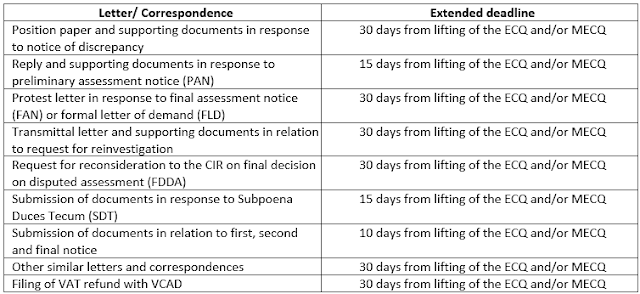
BIR extension


Face-to-face meetings of BIR officials and employees with taxpayers and/or authorized representatives in areas under ECQ/MECQ, are likewise deferred and rescheduled until the lifting of ECQ and/or MECQ.

Moreover, the running of the statute of limitations for assessment and collection of deficiency taxes is suspended in affected areas while ECQ and/or MECQ is in effect, and for sixty (60) days thereafter.

The above extension of deadlines and suspension of the statute of limitation shall also apply in case of any future declarations of ECQ and/or MECQ by the government.

You can visit BIR's website here to get copy of the revenue memorandum circulars 92-2021 ans 93-2021.


Comments

Popular posts from this blog

REVENUE REGULATIONS (RR) 26-2002 : EFPS INDUSTRY GROUPS

The revenue regulation issued on 05 December 2002 as presented below, is a modified version of the original RR 26-2002 to cope with the needs of the users of this website and for easy understanding of Electronic Filing & Payment System (EFPS) implemented by the Bureau of Internal Revenue. follow the blog author through his  facebook  page, twitter , instagram , and google+ ___________________________________________________________________________________ REPUBLIC OF THE PHILIPPINES DEPARTMENT OF FINANCE BUREAU OF INTERNAL REVENUE Quezon City December 05, 2002 REVENUE REGULATIONS NO. 26-2002 SUBJECT : Amending Further Revenue Regulations No. 9-2001, as Amended by Revenue Regulations No. 2-2002 and Revenue Regulations No. 9-2002, Providing for the Staggered Filing of Returns of Taxpayers Enrolled in the Electronic Filing and Payment System (EFPS) Based on Industry Classification. TO : All Internal Revenue Officers and Others Concerned. SECTION 1. SCOPE. –...

OPERATIONS AUDIT: WRITTEN ASSIGNMENT WEEK 5

Submit a 2-3 pages paper assignment, (excluding the title page and reference page) double-spaced in  Times New Roman  font which is no greater than  12-points in size . Paper and all citations should be in APA format. Send it to  maggrabillo@rtu.edu.ph  once completely accomplished.    1. List the 7 Es according to importance or with the greatest impact on the organization. Explain how they impact the business. 2. Link the concept of excellence to the work of internal auditors and how can it be incorporated in audit programs. 3. How can failure in ethics affect organizational success? Choose one company that failed as to its ethics. 4. Describe ways to monetize the concept of ecology. How can you encourage others to observe environmental stewardship? After sending through email,  kindly post in rich text format your case analysis by commenting  on this post.  Deadline for accomplishment:  November 28, 2021 11:59PM

OPERATIONS AUDIT: DISCUSSION ASSIGNMENT WEEK 8

PROJECT MANAGEMENT & CHANGE MANAGEMENT Project management and change management are often confused. Although they both involve managing people and processes (and often work together to meet organizational goals), they are different disciplines (Lucid, n.d.). Understanding what those differences are and how both practices can (and should) work together to manage projects and their resulting changes is crucial for the success of your organization. The term “project management” can at once feel both obvious and vague. While most people intuitively understand what project management is, it’s useful to refer to the official definition. Project management is described as the application of knowledge, skills, tools, and techniques to meet project requirements. In other words, project management is about the process required to bring a team or product from point A to point B. To do this, project managers and their teams manage processes within five main project stages: Initiating Planning...